

What if the world’s most image-driven poetic form could be mastered without a mind’s eye?
For millions of people living with aphantasia, the inability to create mental images, poetry—and haiku in particular—can feel like a closed door. Traditional advice often assumes you can “picture” a scene, “imagine” a moment, or “visualize” a detail. But what if you can’t?
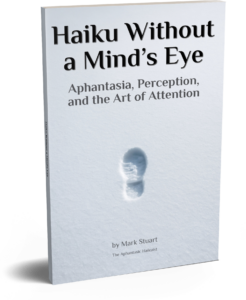
Haiku Without a Mind’s Eye is the first book to explore haiku through the lived experience of multi-modal aphantasia—no pictures, no recreated sounds, no sensory memory—and to show how the art of haiku not only survives without imagery, but in many ways thrives.
Drawing on Japanese aesthetics, close readings, and the author’s own practice as The Aphantasic Haikuist, this book reveals how haiku works at its deepest level: not through mental pictures, but through attention, relationship, pattern, and the subtle emotional shift known as the kire.
Across thirteen calm, reflective chapters, you’ll discover:
- How haiku communicates meaning beyond visualization
- How to read and write haiku without relying on mental imagery
- Why kigo (season words) and atmosphere resonate even when you can’t “see” them
- How to use prompts—words, phrases, or images—without needing to picture them
- Why haiku is fundamentally a poetry of perception, not imagination
- What changes (and what doesn’t) when the mind’s eye is silent
- How aphantasia can actually sharpen your haiku, not limit it
You’ll also find new haiku by the author woven throughout—poems written entirely without visualization—showing how the form opens itself to readers regardless of how their minds work.
Whether you are:
- an aphant looking for a way into haiku,
- a haiku poet wanting to understand how others experience poems differently,
- a writer exploring perception, cognition, and creativity, or
- a reader simply drawn to quiet attention and the art of noticing,
this book offers a fresh, inclusive approach to one of the world’s most subtle poetic forms.
Haiku does not require images.
It requires presence.
And that skill—attending, noticing, feeling the shift between two parts of a poem—is available to everyone, with or without a mind’s eye.
Haiku Without a Mind’s Eye is currently available on:
P.S. This article might also be of interest.